The Complete Personal Productivity Manual
Everything we've learned about staying productive without burning out, distilled into one long guide. Capture, plan, focus, review — with the Tellzm setup that makes each habit easy to keep.
The system you actually maintain beats the perfect system on a spreadsheet, every time.
Most personal-productivity advice fails the same way: it assumes you have infinite time to maintain the system. Five minutes a day on capture, ten on planning, twenty on a weekly review, an hour-long monthly retrospective. Add it up and you're spending six hours a month on productivity — six hours that aren't productive.
This guide is built around a different premise: the system should cost you less than 15 minutes a day. If it costs more, you'll skip it. The skipped system is no system. Below is what 15 minutes a day looks like — and why every minute of it pays back at least 10×.
Part 1 — The five-minute morning capture
Capture is the foundation. If you don't capture, you're carrying every commitment in your head — which means your head is busy holding things instead of doing them. The best productivity systems all start with the same move: get everything out of your head and onto a list.
What to capture
- Things you'll do today or this week — obviously.
- Things you'll never do but feel guilty about not doing — capture them anyway, then deliberately drop them in the Friday review.
- Ideas, things to look up, books to read, people to follow up with.
- Anything mid-meeting that you don't want to forget but isn't the meeting's topic.
Where to capture
Your personal Inbox in Tellzm. It's a single bucket that takes everything — no categorization, no tagging, no decision-making at capture time. Capture friction kills systems. Make capture frictionless and you'll actually use the system.
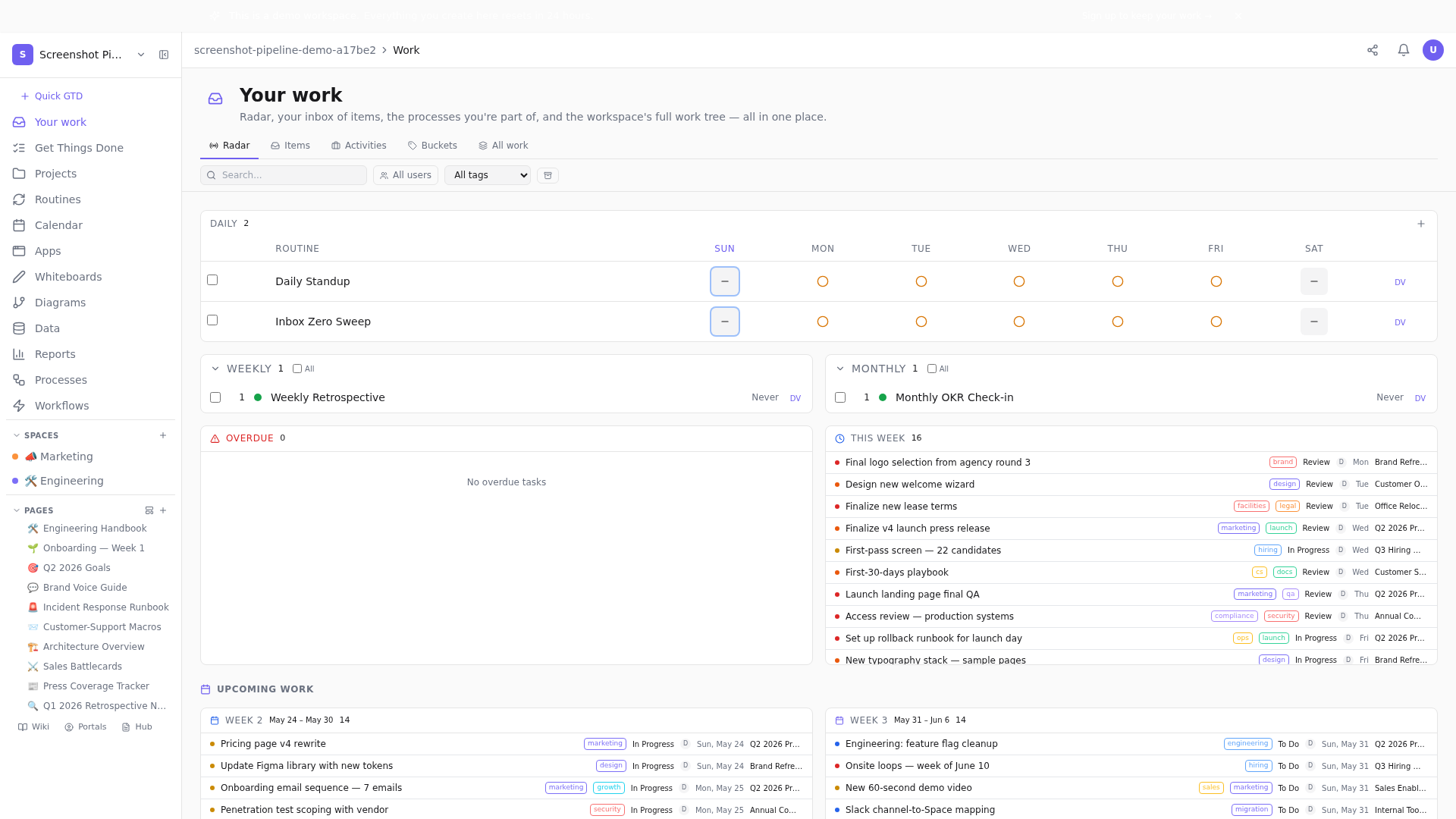
GTD in Tellzm: The Complete Playbook
The full GTD model with all five stages — capture is stage one.
Part 2 — The noon sweep
Five minutes around lunch. Open Inbox. For each item, make one of four decisions: do it now (if it takes less than two minutes), schedule it as a Today task, move it to Next, or send it to Someday. Don't agonize. The point isn't perfect categorization — it's just getting the inbox to zero.
The Two-Minute Rule, Done Right
Why the two-minute rule is misunderstood by most people who try to follow it.
The four buckets, used ruthlessly
- Today — capped at 5. If you have 6, one of them is a lie.
- Next — actionable but not today. Maximum 20. Above that, you can't actually scan it.
- Waiting — blocked on someone else. Each has a date when you'll ping them if no answer.
- Someday — not now, not soon, maybe never. Reviewed monthly. Three deletions per month, minimum.
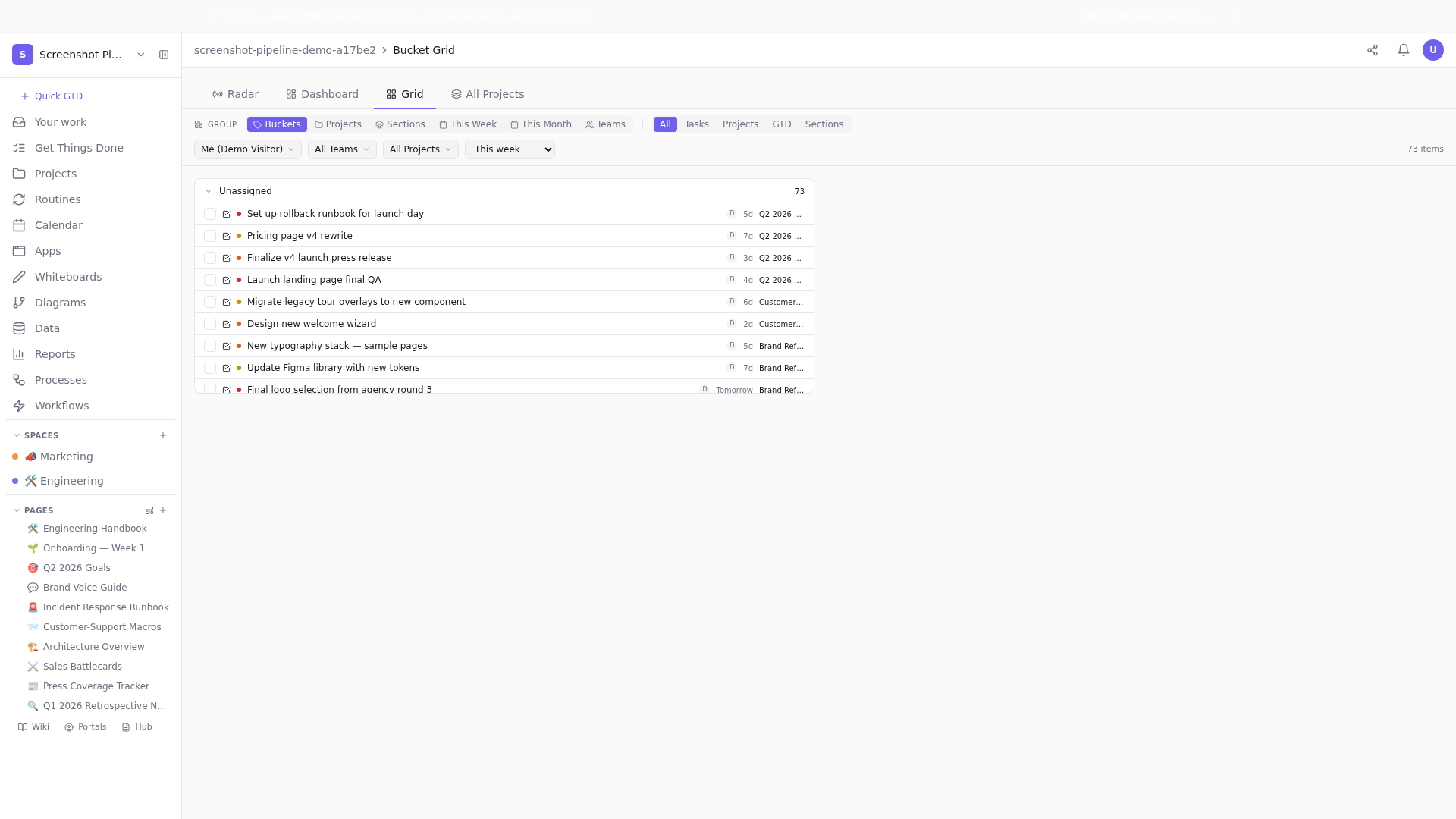
The Discipline of Someday/Maybe
How to use the Someday bucket without it becoming a graveyard.
Part 3 — Defending deep work time
Capture and clarify get you a clean inbox. They don't make you productive — they just make the productivity possible. Productivity itself happens during deep work blocks: 90 uninterrupted minutes spent on the highest-leverage item on your list.
Deep Work Blocks in a Noisy Week
How to carve out and defend two 90-minute deep-work blocks per day.
What deep work actually requires
- A specific task name on the block — not 'deep work', but 'finish the v4 launch press release first draft'. Specificity is what locks it in.
- 90 minutes, not 60 — the first 20-30 minutes are warm-up. The real work happens minute 30 onward.
- Notifications off — including the one from your watch. Especially the one from your watch.
- A clear stopping point — what does 'done' look like for this block? Write it on a sticky note before you start.
Why two blocks a day, not four
Sustained deep work is rare. Most people max out at three hours of true deep work per day. Two 90-minute blocks fits in that ceiling with room for the inevitable interruptions. Trying to schedule four blocks means three of them will be shallow imitations.
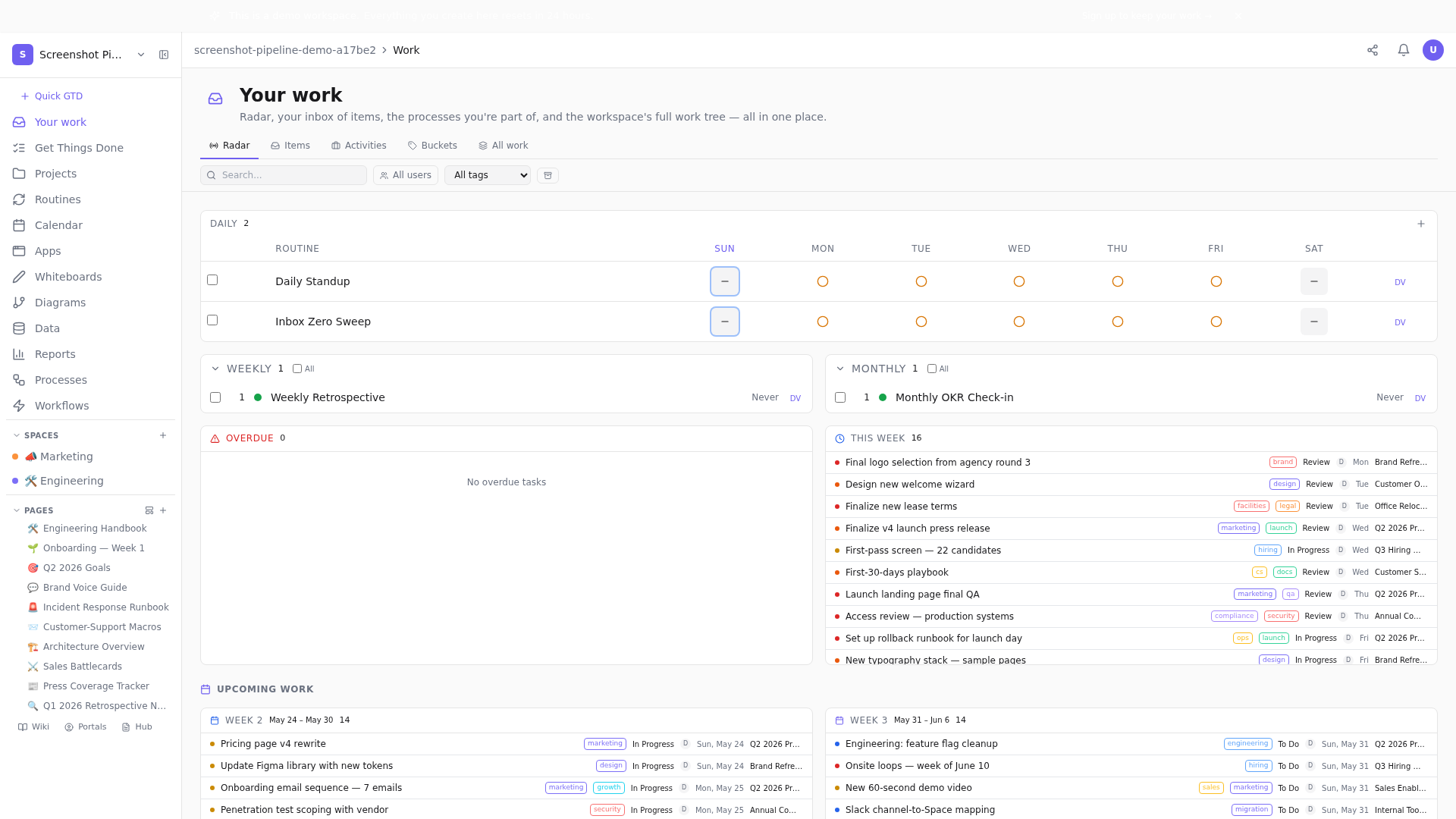
Part 4 — Energy, not just time
Productivity advice treats time as the limited resource. For most knowledge workers, it isn't — energy is. You have 16 waking hours; you have maybe 6 hours of high-quality cognitive output per day. The trick is matching your hardest work to your highest-energy hours, not packing every hour with something.
Knowing your peak hours
For two weeks, log your energy level at the end of each two-hour block on a 1-5 scale. By the end of week two, your pattern is obvious. Most people peak in the late morning (10am-noon) and have a second smaller peak in the early afternoon. Almost everyone hits a wall between 2pm and 3:30pm — that's lunch energy and the post-prandial dip combining.
Matching work to energy
- Peak energy → hardest cognitive work. Writing the strategy doc, the difficult conversation, the architectural decision.
- Medium energy → meetings, emails, reviews. Tasks where you respond to a thing someone else built.
- Low energy → administrative tasks. Inbox cleanup, scheduling, paperwork. The 'I'll do this when I can't do anything else' bucket.
Don't fight your energy. Work with it. The deepest work goes where the deepest focus is.
Part 5 — The boundary discipline
The single highest-leverage skill in personal productivity isn't capture or focus — it's saying no. Every yes is a no to something else, but most people only see the yes. They look up six months later and realize they've said yes to 50 things and no to nothing, and now they're miserable.
Saying No Without Burning Bridges
Three scripts for the most common saying-no situations — including the meeting request you can't take and the feature request you'll never build.
The default-no posture
Start every new request from no, then argue yourself into yes. Most people start from yes and argue themselves into no — which means they spend more energy on the argument and end up at yes anyway. The default-no posture means the bar to add a commitment is higher than the bar to leave it off your list.
Boundaries with your calendar
- No meetings before 10am — that's your peak-energy hour. Protect it.
- No meetings without an agenda — if you can't see what decision will be made, decline.
- One no-meeting day per week — block it on your calendar. Defend it like a deadline.
- End at a sane hour — work expands to fill the time available. If you stop at 6, you'll finish what mattered by 6.
Part 6 — The weekly review (do this Friday)
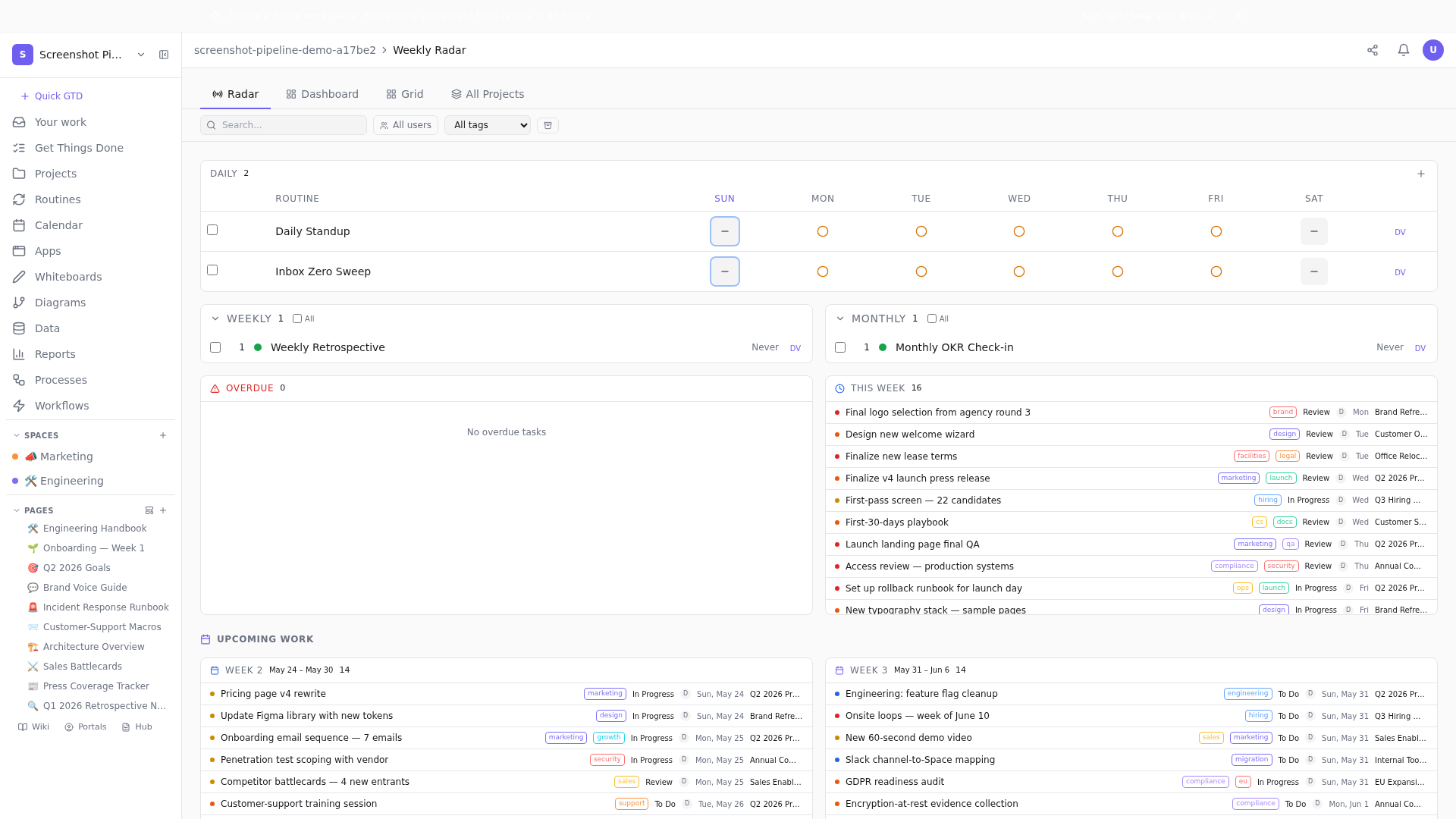
The weekly review is the most important habit in the system. Skip it and the rest unwinds within two weeks. We've designed ours to take five minutes — short enough that you never skip it.
The Five-Minute Weekly Review
The full five-minute review checklist, minute by minute.
Why Friday and not Monday
Friday review captures the week while it's fresh and starts next week on the right foot. Monday review starts the week with cleanup instead of execution. Do the review Friday and Monday morning becomes 'open Today, start working' instead of 'figure out where I left off'.
What gets carried, what gets killed
- Anything that was in Today for three days but didn't move → demote to Next or kill.
- Anything in Waiting older than 7 days with no chase → chase now or kill.
- Anything in Someday older than 90 days with no change → kill. Probably.
Part 7 — Sunday-night planning (do this Sunday)
Friday closes the previous week. Sunday opens the next one. Fifteen minutes spent planning Sunday night saves you four hours of reactive Monday-morning fumbling.
The Sunday-Night Weekly Plan
The exact 15-minute Sunday-night ritual.
Set three outcomes, not twelve tasks
The mistake most people make Sunday night: making a long task list. Resist it. Pick three outcomes for the week — things you'll be proud to point to on Friday. Then think about which tasks ladder up to each outcome, and put those tasks on Today as you reach each day.
Part 8 — Reading the signals: when to change something
Productivity systems aren't set-and-forget. They drift as your work changes — and the signals that something needs to change are subtle. Watch for these.
Signals it's working
- You go to bed Sunday without dread about Monday.
- You can name three things you shipped last week without looking.
- Your Inbox hits zero at least four days a week.
- You're not bringing work into the weekend more than once or twice a month.
Signals it's drifting
- Inbox is over 30 items for two weeks straight — capture has gone up but sweep has gone down.
- Today has the same five things on it three days in a row — you've stopped being honest about what 'today' means.
- Weekly review skipped twice — the load-bearing habit is gone, and the rest will follow within two weeks.
- You're saying yes to things that don't ladder up to any of your three weekly outcomes.
Signals to overhaul
If three drift signals stack up at once, don't try to patch them. Spend an hour on Saturday doing a full reset: empty Inbox to zero (drop anything older than 60 days), pick three outcomes for the next two weeks (not one — accept the system was off), and rewrite your Friday review checklist if anything in it doesn't fit your current work.
The point of all this
Personal productivity isn't an end in itself. The point of the system is to free your attention from juggling, so you can spend it on the work itself. A capture habit doesn't make you a better writer — it lets you focus while writing. A weekly review doesn't make you a better manager — it lets you walk into Monday with a clear head.
If the system starts becoming the work, you've made it too complicated. Strip it back. 15 minutes a day, five days a week. That's the budget. Stay inside it and the system will outlast every other productivity book you've ever read.
Productivity is keeping your mental load on a shelf, not in your head.Open a demo workspace and set up your Inbox → Today → Done loop in five minutes.
Related posts
Personal Productivity Without Burning Out
The honest version: most personal-productivity systems collapse in week three. Here's a minimal Tellzm setup that survives a year.
Deep Work Blocks in a Noisy Week
Two 90-minute focus blocks per day will outperform eight hours of scattered attention. Here's how to carve them out and protect them in Tellzm.
The Sunday-Night Weekly Plan
Fifteen minutes Sunday night save you from reactive Mondays. Here's the exact ritual.
Saying No Without Burning Bridges
The single highest-leverage productivity skill: ending a meeting request with respect intact. Here's the script.